Noise Exposure Testing
Manage the Risk.
Control the Exposure.
Memtech provides noise exposure testing and develops remedial strategies to help protect employees, meet OSHA requirements, and make informed, data-driven decisions.
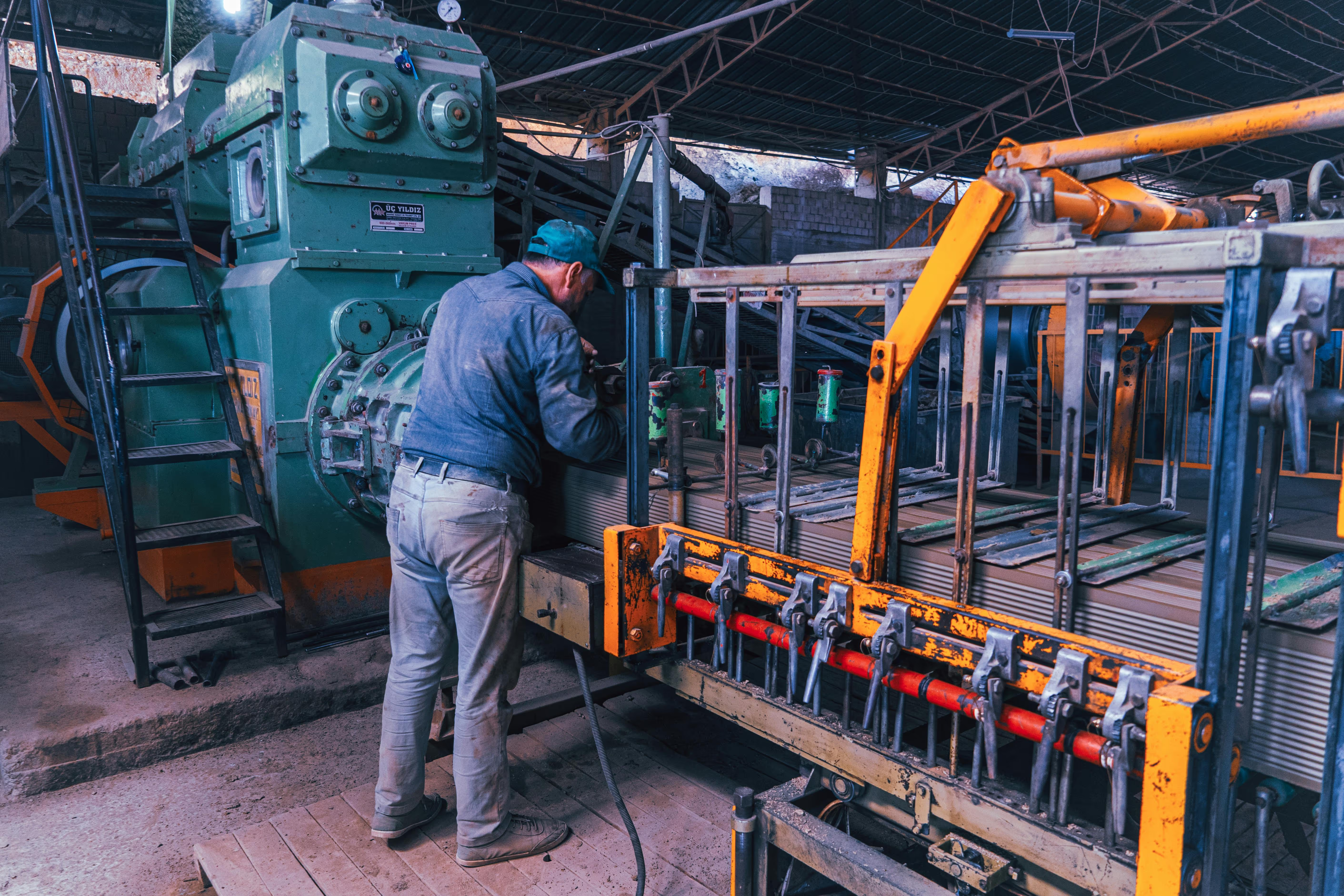
Why Noise Exposure Testing Matters
Excessive noise isn’t just uncomfortable, it’s a regulated workplace hazard. Under OSHA 29 CFR 1910.95, employers are required to monitor worker exposure and implement controls when "action levels" of noise exposure are exceeded.
According to OSHA, any workplace where employees are exposed to an average of 85 decibels (dBA) or higher over an 8-hour shift must implement a hearing conservation program.
Whether you’re responding to employee concerns, preparing for an audit, or proactively evaluating risk, noise exposure testing is the first step to protecting your team and your bottom line.
According to OSHA, any workplace where employees are exposed to an average of 85 decibels (dBA) or higher over an 8-hour shift must implement a hearing conservation program.
Whether you’re responding to employee concerns, preparing for an audit, or proactively evaluating risk, noise exposure testing is the first step to protecting your team and your bottom line.
Unmanaged occupational noise can lead to:
- Increased workers’ compensation claims
Permanent hearing loss, tetanitus, fatigue, and stress. - Miscommunication
Increased accident risk due to high background noise levels which impede warning alarms, muddle verbal instructions and reduce worker concentration. - Decreased employee productivity
Loud environments reduce focus, comfort, and job satisfaction. - Regulatory citations or fines
Noncompliance opens the door to fines, citations, and injury litigation.
Noise exposure studies provide you with the data you need to identify high-risk areas and prioritize corrective actions before problems escalate.

What We Test.
How We Do It.
Our noise testing process is grounded in engineering discipline and regulatory best practices. Every project is conducted by licensed engineers and acoustic professionals using NIST-traceable, calibrated equipment.
Personal Exposure Levels (Dosimetry)
Employees wear small, data-logging devices to collect sound exposure data during a work shift to calculate time-weighted averages (TWA), peak levels, and allowable noise dose statistics.
Area and Task-Based Noise Mapping
Fixed-point measurements and sound level data is acquired at key process locations or job stations to pinpoint dominant sources, problem areas and exposure patterns.
Octave Band Analysis
Frequency-based data is used to identify the content of noise, and is critical for selecting the most effective noise mitigation products (e.g., enclosures, surface treatments, or diffusers).
Equipment-Specific Diagnostics
Targeted testing around specific machines or systems to evaluate the noise-exposure impact of problematic assets.
Compliance Documentation
Complete OSHA/NIOSH-compliant reporting, including threshold exceedance mapping, recommendations, and documentation suitable for internal audits or agency review.
Our Process
STEP 1
Discovery & Qualification
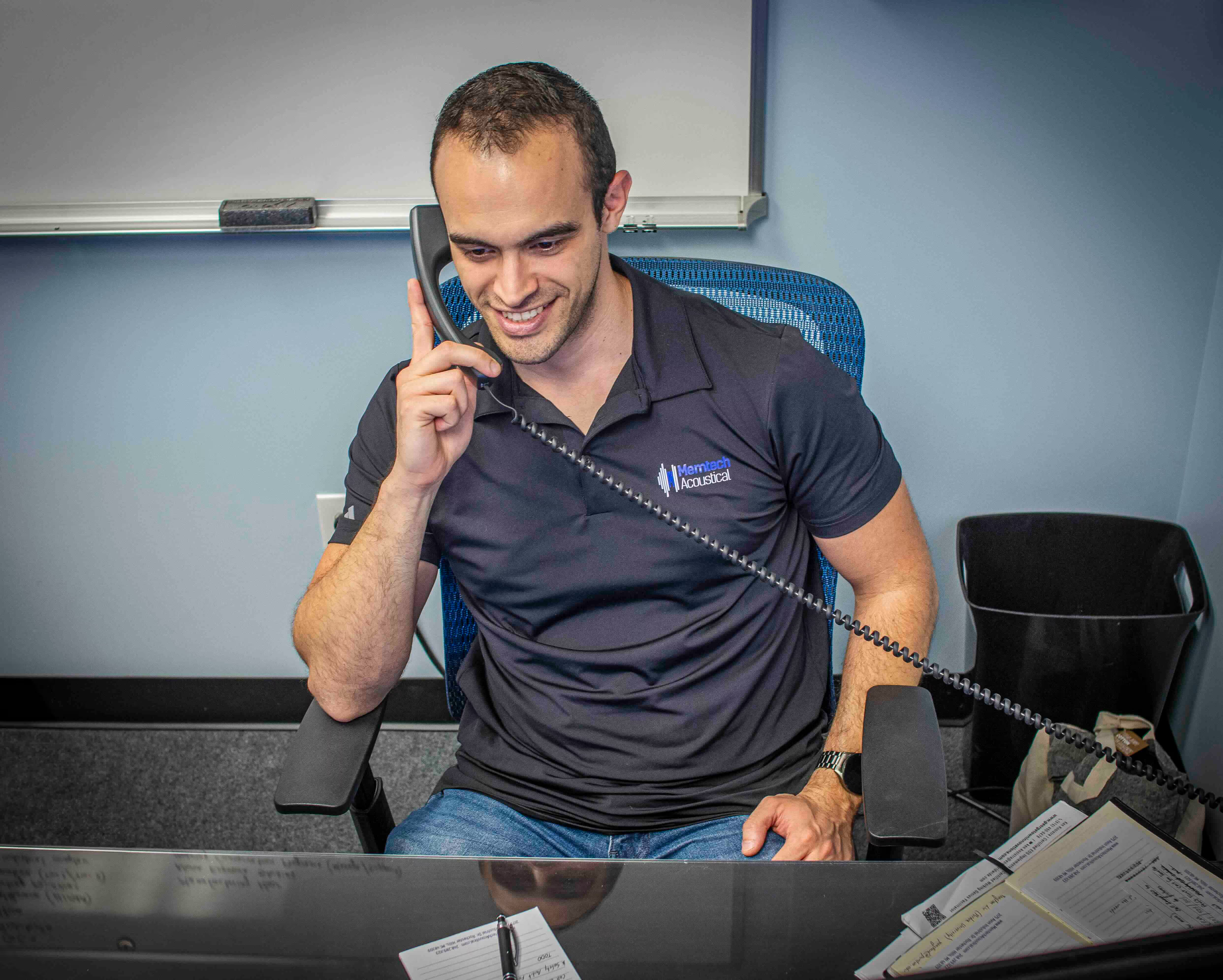
We start with a collaborative factfinding process to understand your site conditions, challenges, and goals.
We also assess risk, establish requirements, and align on priorities.
We also assess risk, establish requirements, and align on priorities.
Here are the types of questions we typically ask:
Which job roles, machines, or production lines are active during a normal work shift?
Are there any known transient or random noise sources (e.g., alarms, forklifts, relief valves) that may influence exposure levels?
What production zones or process areas are of most concern for ambient noise?
Are there any upcoming operational changes (e.g., new equipment, shift expansions) that may affect the acoustic environment in the near term?
How will the results be used (i.e. internal risk assessment, OSHA compliance validation, community engagement, litigation, etc.)?
STEP 2
On-Site Testing
After our initial assessment, we then proceed with a guided walkthrough of your facility to identify key noise sources, workflow patterns, and employee exposure risks.
Our team maps out critical equipment zones, identifies job roles with high exposure potential, and observes how production shifts influence the acoustic environment.
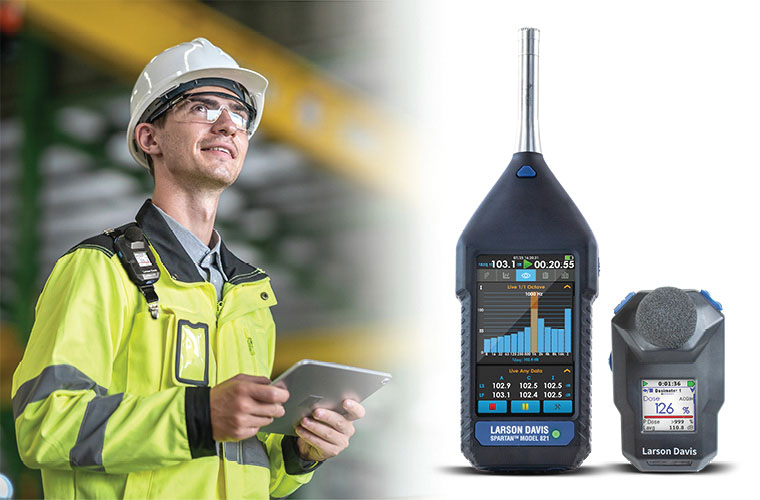
Using certified Class 1 sound level meters and OSHA-compliant noise dosimeters, we conduct on-site testing during active operations.
Employees are introduced to the data acquisition process, and then outfitted with the dosimeters to capture comprehensive noise exposure statistics throughout the work shift. The dosimeters do not interfere with normal work routines.
For in-depth analysis in high-risk areas, we perform octave-band and temporal noise testing to determine root-causes of problematic noise.
Our team maps out critical equipment zones, identifies job roles with high exposure potential, and observes how production shifts influence the acoustic environment.
Using certified Class 1 sound level meters and OSHA-compliant noise dosimeters, we conduct on-site testing during active operations.
Employees are introduced to the data acquisition process, and then outfitted with the dosimeters to capture comprehensive noise exposure statistics throughout the work shift. The dosimeters do not interfere with normal work routines.
For in-depth analysis in high-risk areas, we perform octave-band and temporal noise testing to determine root-causes of problematic noise.
STEP 3
Analysis & Reporting
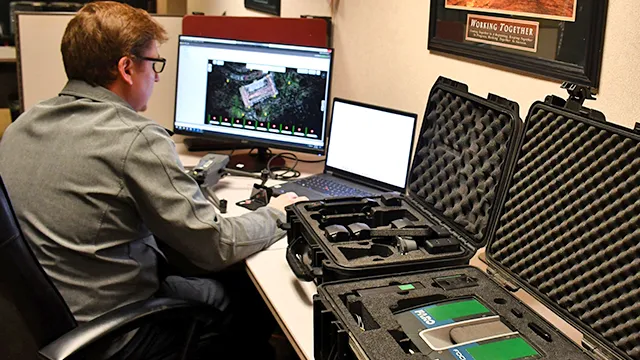
After testing is complete, we review and process all collected data, comparing results against OSHA permissible exposure limits (PEL), action levels, and hearing conservation thresholds.
Our team evaluates individual exposure profiles and area-based noise levels to identify compliance risks, locate high-noise "hotspots," and determine potential noise mitigation measures.
We then deliver a comprehensive report summarizing all findings.
Our team evaluates individual exposure profiles and area-based noise levels to identify compliance risks, locate high-noise "hotspots," and determine potential noise mitigation measures.
We then deliver a comprehensive report summarizing all findings.

STEP 4
Actionable Guidance
Our reports fully comply with OSHA and NIOSH documentation requirements,as well as with any local or union-related mandates
Each report includes:
- Raw data and statistical summary breakdowns
- Sound pressure level mapping, along with frequency information (where necessary)
- Written summaries and compliance observations
- Recommended next steps
STEP 5
Ongoing Monitoring (Optional)
For clients seeking long-term risk management or who are operating in constantly changing work environments, we offer long-term noise monitoring and periodic reassessments.
Whether it’s due to seasonal production changes, new equipment, or evolving compliance requirements, continuous acoustic oversight helps ensure your workplace stays within regulatory thresholds.
Whether it’s due to seasonal production changes, new equipment, or evolving compliance requirements, continuous acoustic oversight helps ensure your workplace stays within regulatory thresholds.
We provide:
- Recurring noise exposure testing (quarterly, semi-annual, or annual)
- Noise logger deployment for long-term tracking of ambient noise trends
- Trend reporting and comparative analysis over varying time periods or operational states
- Regulatory reviews aligned with OSHA recordkeeping and hearing conservation programs
What Our Clients Say
“Memtech has always been very responsive and produced excellent solutions for our site”
- Nathan Nash, Team Leader, Magnolia Gas Storage, Louisville KY
"Memtech Acoustics was a savior! We had an audit, and they were able to fit us in on short notice and met all the requirements we needed. Highly Recommend!!!"
- Preferred Marble & Granite, Fraser, MI
- Nathan Nash, Team Leader, Magnolia Gas Storage, Louisville KY
"Memtech Acoustics was a savior! We had an audit, and they were able to fit us in on short notice and met all the requirements we needed. Highly Recommend!!!"
- Preferred Marble & Granite, Fraser, MI

The Memtech Difference
At Memtech, noise is our business. Our engineers oversee every step, ensuring that each project is properly delivered, on-time and within budget. This integrated approach delivers predictable results and protects your investment.

Certified and Licensed Professionals
Testing conducted by certified engineers and acoustic specialists, not general contractors or “safety consultants.”

National Standards Alignment
We follow OSHA 1910.95, NIOSH criteria, and ANSI S12.19-1996 methods for noise exposure assessment. Measurements are conducted via ISO procedures or per academically accepted methods.

Engineering Expertise
Noise measurements, analysis, modeling and installation support are overseen by professionals who understand acoustic theory, as well as the implementation of practical solutions.
High Responsiveness, Proven Reliability
We are your trusted local partner providing on-demand support and dependable project execution. Michigan-based with regional reach and national* shipping capabilities.

Confidential & Detailed Reporting
We don’t just submit a report. You are provided with complete documentation, delivered in easy-to-understand language with accurate data and comprehensive drawings.
*Shipping available across the continental USA, and international; installations are offered in select regions.
NOTE: We do not stock custom products in our U.S. warehouse. Ask us about lead times for your project.
NOTE: We do not stock custom products in our U.S. warehouse. Ask us about lead times for your project.
Frequently Asked Questions (FAQs)
What is noise exposure testing and why is it important?
Noise exposure testing measures how much sound workers are exposed to over time. It ensures compliance with OSHA 29 CFR 1910.95 and helps protect employees from hearing loss, fatigue, and long-term health effects.
What are OSHA’s noise exposure limits?
OSHA’s "Permissible Exposure Limit (PEL)" is based on a time-weighted average (TWA) of 90 dBA over 8 hours. Exposure over this level usually requires immediate action and can be cause for significant legal action and penalties. The "Action Level" is set at 85 dBA TWA, which requires implementation of a Hearing Conservation Program, often mandating regular testing, audiometric evaluations, and employee training.
How is noise exposure testing performed?
Testing typically combines:
Personal dosimetry – worn by employees to measure individual noise exposure during shifts.
Ambient monitoring – using sound level meters and other instrumentation to capture environmental noise levels in work zones.
Frequency analysis – identifying tonal noise or objectionable noise sources.
Personal dosimetry – worn by employees to measure individual noise exposure during shifts.
Ambient monitoring – using sound level meters and other instrumentation to capture environmental noise levels in work zones.
Frequency analysis – identifying tonal noise or objectionable noise sources.
How often should noise exposure testing be conducted?
OSHA requires testing whenever workplace conditions change, such as new machinery, production processes, or facility layouts. Many employers perform annual testing as part of their ongoing hearing conservation programs to stay compliant and proactive.
What industries require noise exposure testing most often?
Common industries include manufacturing, construction, energy, automotive, aerospace, food processing, warehousing, and logistics. Anywhere machinery, tools, or equipment produce sustained sound above 85 dBA.
What happens if we exceed OSHA limits?
If exposure exceeds the Action Level (85 dBA TWA), a Hearing Conservation Program must be implemented. If exposure exceeds the PEL (90 dBA TWA), employers are required to implement engineering or administrative controls and provide mandatory hearing protection devices (HPDs) until levels are reduced.
Do you provide compliance-ready reporting?
Yes. We deliver comprehensive, defensible reports that include measurement methods, noise exposure statistics, plant ambient noise maps, frequency analysis, and recommendations. Reports are structured for OSHA compliance, insurance audits, and internal EHS programs.
Let’s Engineer the Right Solution, Together.

Let's Get Started. Contact Us.
Talk to our experts. We’ll assess your needs and recommend a solution that works for your project.